
The RCOE Instructional Services mathematics team is here to support the educators that support our students. As we support schools and districts, we strive to provide our students, parents, communities, teachers, coaches, and administrators with services that are equitable and inclusive.
Mathematics


As the Riverside County Office of Education (RCOE) mathematics team supports schools and districts, we strive to provide our students, parents, communities, teachers, schools, and districts with services that are equitable and inclusive.
Appreciating the beauty of mathematics and transforming the world through mathematics.
Each and every student is allowed to use their curiosity and creativity in all forms to recognize and engage with the beauty of mathematics in their communities, to be able to use their mathematical power to function within existing systems, and to change systems in order to contribute to the flourishing of humanity.
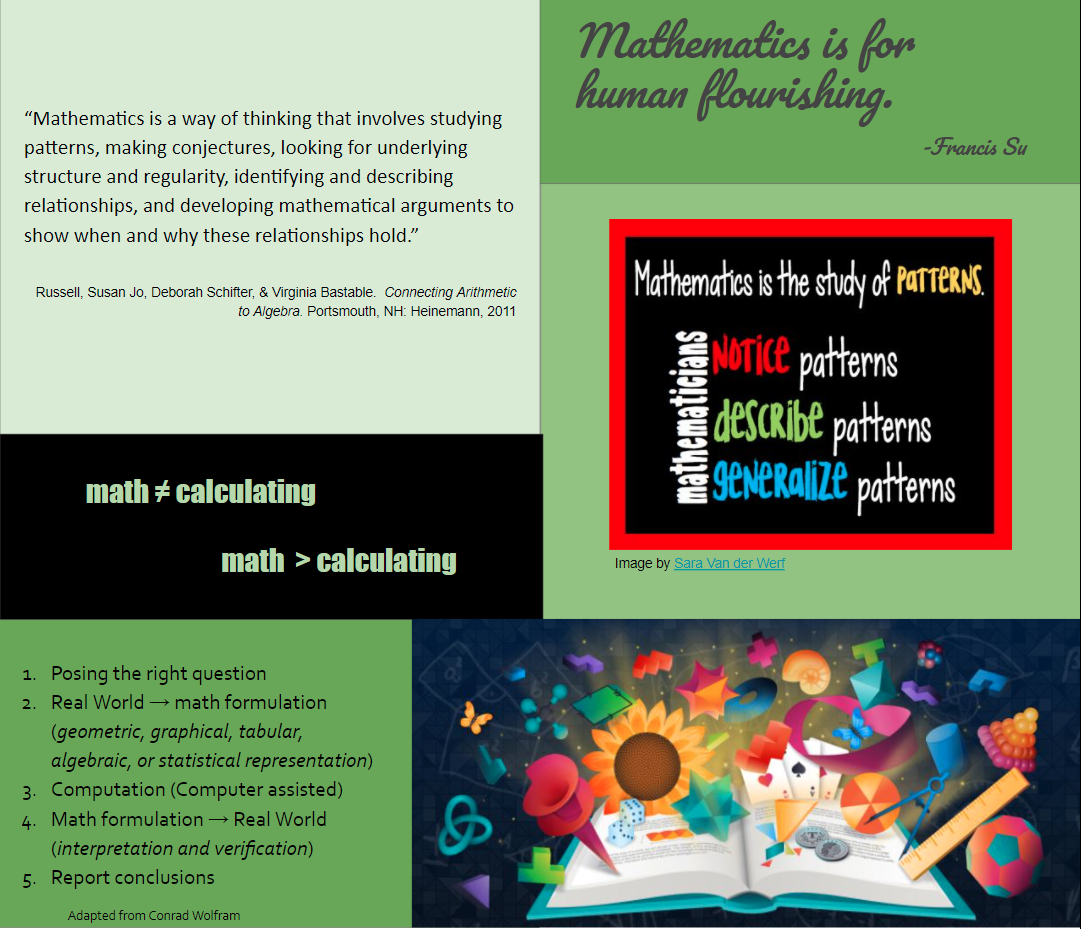
For the Instructional Services team at RCOE, the learning and teaching of mathematics is grounded on how mathematics is defined for the highly technical and quantitative global society, in order that students may appreciate the beauty of mathematics, recognize mathematics in the world, and use mathematics to transform their world
The following definition, provided by Susan Jo Russell, Deborah Schifter, and Virginia Bastable in their Connecting Arithmetic to Algebra (Portsmouth, NH: Heinemann, 2011), describes the scope of mathematical thinking that we seek for all students.
“Mathematics is a way of thinking that involves studying patterns, making conjectures, looking for underlying structure and regularity, identifying and describing relationships, and developing mathematical arguments to show when and why these relationships hold.”
In practice, mathematics can be defined in these five steps, adapted from Conrad Wolfram, Teaching Kids Real Math with Computers (TEDGlobal, 2010).
What is Mathematics?
- Posing the right question.
- Real World → math formulation (geometric, graphical, tabular, algebraic, or statistical representation).
- Computation (computer assisted).
- Math formulation → Real World (interpretation and verification).
-
Report conclusions.


Resources
Teaching for Robust Understanding (TRU) Framework
TRU is a framework for characterizing powerful learning environments in clear and actionable ways. It provides a straightforward and accessible language for discussing what happens in classrooms, in professional preparation and professional learning.
In helping to build TRU professional learning communities, TRU provides a research-based response to the question, “What are the attributes of equitable and robust learning environments – environments in which all students are positioned to become knowledgeable, flexible, and resourceful disciplinary thinkers?”
The following Introduction to the TRU Framework video from our RCOE mathematics team provides an overview and tips for successful implementation.
The Five Dimensions of Powerful Classrooms
The Mathematics
The extent to which classroom activity structures provide opportunities for students to become knowledgeable, flexible, and resourceful mathematical thinkers. Discussions are focused and coherent, providing opportunities to learn mathematical ideas, techniques and perspectives, make connections, and develop productive mathematical habits of mind.
Cognitive Demand
The extent to which students have opportunities to grapple with and make sense of important mathematical ideas and their use. Students learn best when they are challenged in ways that provide room and support for growth, with task difficulty ranging from moderate to demanding. The level of challenge should be conducive to what has been called “productive struggle.”
Equitable Access to Mathematics
The extent to which classroom activity structures invite and support the active engagement of all the students in the classroom with the core mathematical content being addressed by the class. Classrooms in which a small number of students get most of the “air time” are not equitable, no matter how rich the content: all students need to be involved in meaningful ways.
Agency, Authority, and Identity
The extent in which students are provided opportunities to “walk the walk and talk the talk” - to contribute to conversations about mathematical ideas, to build on others’ ideas and have others build on theirs – in ways that contribute to their development of agency (the willingness to engage), their ownership over the content, and the development of positive identities as thinkers and learners.
Formative Assessment
The extent to which classroom activities elicit student thinking and subsequent interactions respond to those ideas, building on productive beginnings and addressing emerging misunderstandings. Powerful instruction “meets students where they are” and gives them opportunities to deepen their understandings.
Observe the Lesson Through the Eyes of a Student
The Mathematics
- What’s the big mathematical idea in this task?
- How does it connect to what I already know?
Cognitive Demand
- How long am I given to think and to make sense of things?
- What happens when I get stuck?
- Am I invited to explain things, or just give answers?
Equitable Access to Mathematics
- Do I get to participate in meaningful math learning?
- Can I hide or be ignored?
Agency, Authority, and Identity
- Do I get to explain, to present my ideas? In what ways are they build on?
- Am I recognized as being capable and able to contribute in meaningful ways?
Formative Assessment
- Do classroom discussions include my thinking?
- Does instruction respond to my thinking and help me think more deeply?
Questions to Ask About Classrooms
The Mathematics
- Is it important, coherent, connected?
- Opportunities for thinking and problem solving?
Cognitive Demand
- Do students have the opportunities for sense-making?
- Do they engage in productive struggle?
Equitable Access to Mathematics
- Who participates in what ways?
- Do all students engage in sense-making?
Agency, Authority, and Identity
- Do students have the opportunity to do and talk math?
- Do they come to see themselves as math people?
Formative Assessment
- Does classroom discussion reveal what students understand, so that instruction may be adapted to help students learn?
More Information on the TRU Framework
Cognitively Guided Instruction
In a Cognitively Guided Instruction (CGI) classroom, problem solving and student thinking is at the center of instruction. Teachers pose purposeful problems, many problem solving strategies are used by students, students communicate their thinking, and teachers use this information to plan further instruction. The RCOE math team is committed to helping districts, sites, and teachers implement CGI.
Principles of CGI
- Every student comes to math class knowing some mathematics.
- Every student is capable of extending their mathematical ideas.
- Knowing the trajectory of children’s thinking helps you know how to support that extension - ”What am I working toward?”
- Details of children’s thinking support instructional decision making.
- Must challenge our assumptions about what students know and are able to do.
- Must create space for the participation of each and honor the different ways in which students are participating.
- Identity shapes participation, so we want to position students competently.
CGI Resources
Downey USD - Cognitively Guided Instruction (CGI)
CGI Books
- Children's Mathematics: Cognitively Guided Instruction
- Extending Children’s Mathematics: Fractions and Decimals
- Young Children’s Mathematics: CGI in Early Childhood Education
- Choral Counting and Counting Collections
Routines and Activities the Align to the Principles of CGI
- Notice and Wonder
- Counting Collections
- Choral Counting
- Number Choice Problems
- Ways to Make
Number Sense Activity - How Many Ways to Make
Embedding Formative Assessment Into Daily Instruction
Assessment becomes formative when the evidence about student achievement is elicited, interpreted, and used by teachers, students, and their peers, to make decisions about the next steps in instruction and learning (Black and Williams, 2009). It is a process, not a test (CDE, 2019).
How to Measure What Matters
- Re-Engagement Lessons
- Empathy Interviews
- Focus Groups
- Student-Led Parent-Teacher Conferences
- Performance Assessments
- Portfolio-based Assessments
- Exhibitions/Presentations
- Quality Review Team
MTF Form Assess Paper - Google Drive
Karon Akins
Administrator
kakins@rcoe.us
Diana Ceja
Administrator
dceja@rcoe.us
Susie E. Jaggers
Administrator
sjaggers@rcoe.us
Dennis A. Regus
Administrator
dregus@rcoe.us
Follow Us
Stay connected with RCOE Math.


